
The Fountain of Youth Part 1
Updated: Sep 17
Mindful Travel
Twenty years ago, while wandering around Southeast Asia, I learned that we don’t start out seeking new places to find ourselves. We mostly travel to escape, to forget and maybe, if we’re lucky, to see our own lives with fresh eyes.

1998–08-Cambodia: Boys playing slipper kicking. Photograph by SIIM.
Yesterday, my first book was published and went live on Amazon — a major personal hurdle, that I’ve been working towards for a year. I almost don’t believe it. My book is called Gallivant: A Travelogue and it is about just that: gallivanting. Me, traveling about, with no fixed agenda and finding myself in strange places with strange people… And journaling — watching myself grow and change in real time.
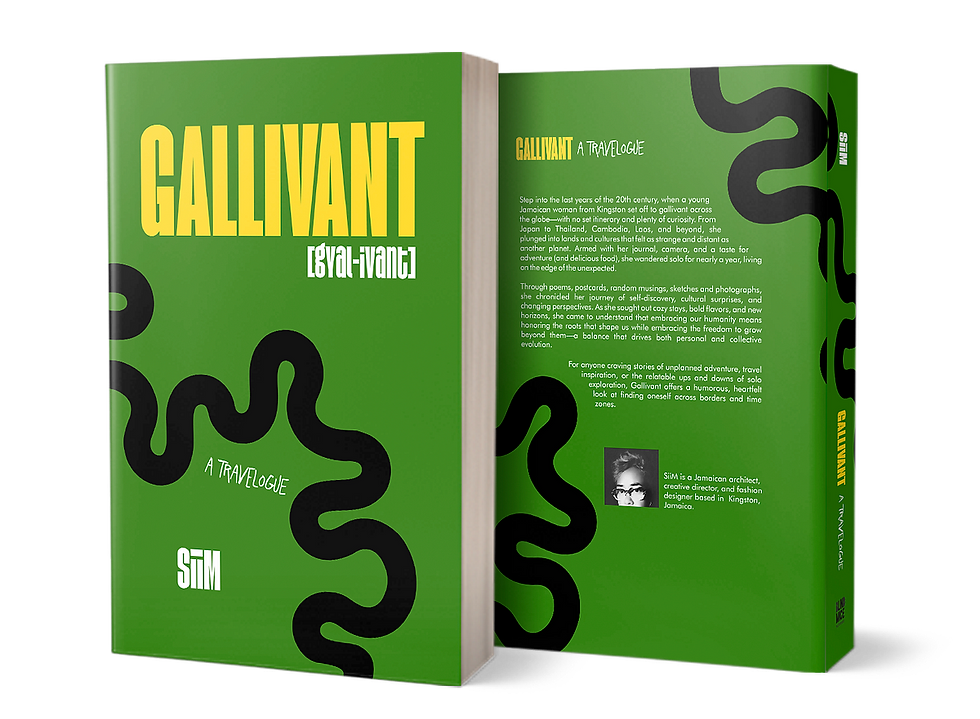
In Gallivant I describe travel as a youth tonic, a magic elixir that made me feel like a kid seeing the world for the first time. It’s ironic that people search far and wide for the mythical Fountain of Youth, not realizing that it is actually in the journey itself. In the act of searching, we open ourselves to newness, discovery, and adventure — the very qualities that keep us young.
Travel as a Youth Tonic
So, I learned that travel is a tonic, not because it reverses age, but because it reminds us how to see without expectations. You can drop the weight of who you’re supposed to be and just be who you are. But travel also has its dark side. As I observed in my journal, “Travelers destroy their destinations,” often turning places into ruins of their former selves.

In this same way, the pursuit of youth can be a double-edged sword, leaving indelible marks on ourselves, our bodies (consider all the cosmetic surgery horror stories) and the places we touch. So, the tonic of travel is not only in where we go, but in how we approach each place, with humility and curiosity.
Releasing Attachments
When you travel for an extended period, unless you are very wealthy, you can’t really take everything you want with you. Every item in your backpack has to earn its keep, and that means letting go of a lot of unnecessary necessities. In Southeast Asia, I found that life was simpler without all the material things that normally surround me. I had less stuff to define (confine) me, which meant I had more freedom to explore who I actually was. That detachment, as painful as it sometimes felt, was a kind of freedom. It is a freedom that is very hard to maintain in daily life (with Amazon Prime and next day delivery).
Childlike Flexibility
One of the great lessons of travel is learning to be flexible. I have come to the realization that children handle change much better than adults because they don’t cling to rigid structures, dogma or arbitrary moral codes. They go with the flow, adapting and rebounding, rolling with the punches. If we could approach life with the same resilience, and a child-like mindset we might spend less time stressing and more time experiencing. As we get older, though, this is harder and harder to do.
The Practice of Grateful Wandering
And then, there’s gratitude. Traveling opens you up to a world of differences, each a reminder of what you have, what you lack, and what you need. My friend Dave always says, “Cultivate an Attitude of Gratitude.” And travel taught me that when you’re constantly arriving in new places and meeting new people, gratitude is like a grounding force. It keeps you humble, connected, and open to the wonders around you.
So here’s the real Fountain of Youth: it’s in the way we approach life, open to the unknown and gratefully embracing each moment with childlike curiosity.
If you want to read about the journey that led me to my Fountain of Youth, check out Gallivant on Amazon here.


Comments